A Community-Focused Earth Day
By Lola Keech, Student Intern & Ambassador for ShelterBox USA, San Marcos High School
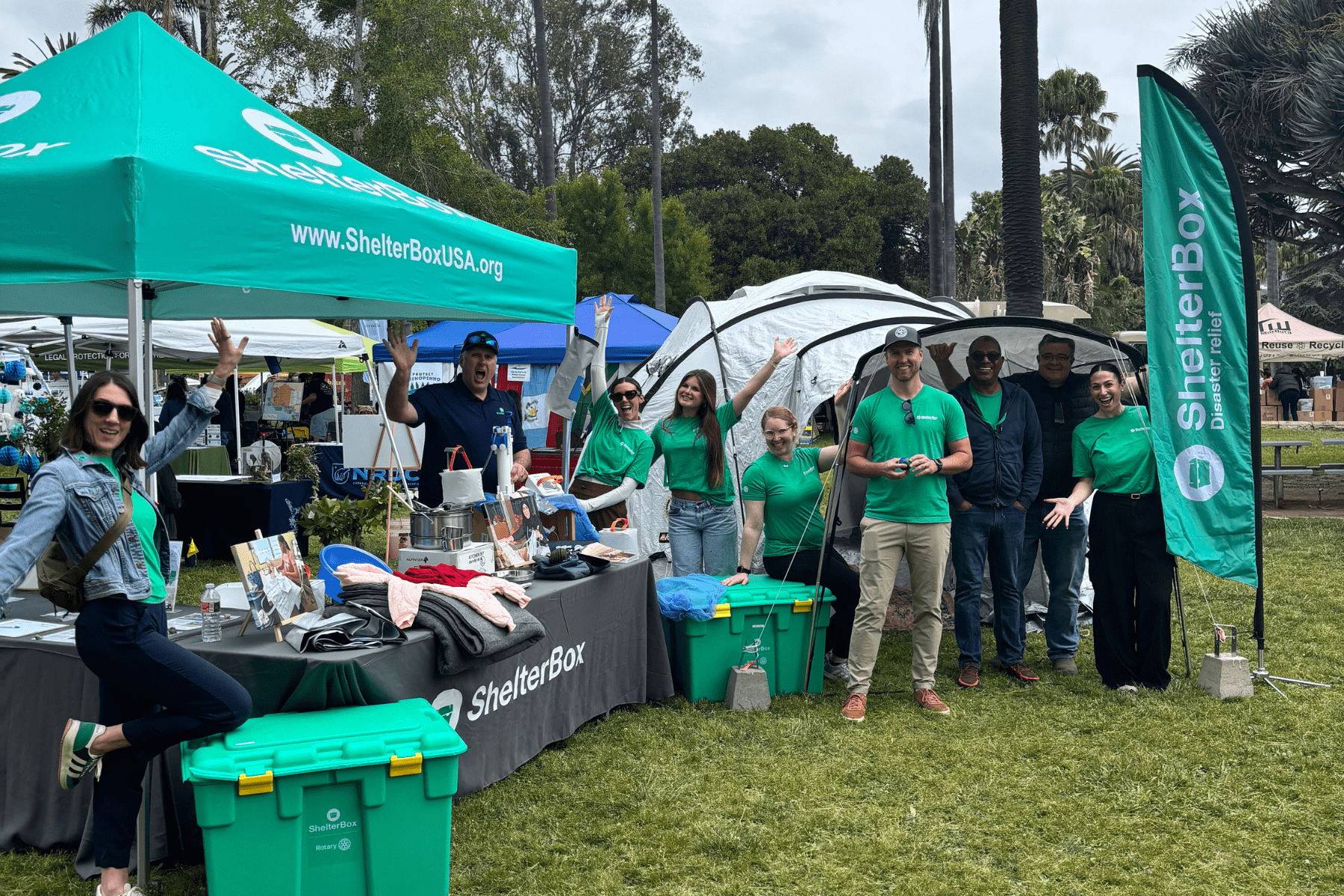
ShelterBox participated in Santa Barbara’s Earth Day event at Alameda Park, an inclusive and vibrant gathering focused on protecting our planet. Amid a range of local organizations and community groups, ShelterBox’s display offered a hands-on look at our work.
As a volunteer and intern, I had the chance to engage directly with our sustainability initiatives. With informative flyers, a ShelterBox tent, and a table of essential aid items, the booth brought our approach to life.
Looking Beyond Short-Term Aid
As an international disaster relief organization, ShelterBox provides emergency shelter and essential household items to people affected by disasters such as earthquakes, conflict, and climate-related crises. Rather than offering only short-term solutions, ShelterBox prioritizes long-term recovery, helping families rebuild their lives with more durable shelter options, including mud brick homes.
The Earth Day event highlighted the urgency of supporting people impacted by disasters, many of which are becoming more frequent and severe due to climate change. At the same time, it was not just a message of urgency. ShelterBox responses help restore dignity and stability, and sustainability is part of that impact.
Conversations at the event showed how sharing these stories can inspire others, reinforcing the idea that even small actions can create meaningful change.
Partnerships Make Progress Possible
One of the biggest takeaways for me was the role of partnership. Tackling questions like “how can we be more sustainable?” is not something any one organization can do alone.
At ShelterBox, those questions are met with collaboration and action. Partnerships with Rotary International, other NGOs, and local communities are essential to building more sustainable solutions.
This spirit of collaboration also extends beyond traditional humanitarian work. ShelterBox recently partnered with filmmaker Kerrilee Gore, who wrote and directed Stand By Mother, a film that explores environmental responsibility through the eyes of children. ShelterBox hosted a free screening at the Alcazar Theatre in Carpinteria.
The film focused on everyday actions—conserving resources, reducing waste, and showing empathy—highlighting that sustainability is not just about large-scale solutions, but also about collective effort.
Reducing Environmental Impact in Every Response
ShelterBox continues to adapt its approach to reduce environmental impact across its operations. Responses are tailored so that families receive what they truly need, avoiding unnecessary waste.
The organization has removed non-essential plastic packaging from kitchen sets and aligned core items with United Nations and Red Cross packaging standards, eliminating over 500,000 pieces of problematic plastic. Whenever possible, ShelterBox uses sea freight instead of air transport and stores aid in regional depots to shorten supply chains and reduce emissions.
Turning Waste into Opportunity
Creativity also plays a role in sustainability. In Mozambique, in partnership with CARE, communities repurposed tarpaulin bags and baling straps into walls and doors for latrines, improving privacy and safety for women.
In Somalia, alongside Juba Foundation, materials like plastic packaging are woven into baskets and mats. These efforts not only reduce waste but also create opportunities for income, turning discarded materials into valuable resources.
A Shared Responsibility
Sustainability at ShelterBox supports both the environment and the people we serve. Being part of the Earth Day event made that especially clear to me. It reinforced how deeply this commitment is embedded in the organization’s work, and how much can be achieved when communities, partners, and individuals come together.